

Principal investigator
Edoardo Datteri
Budget
€ 1.5 million
Funding program
FIS Advanced Grant (Fondo Italiano per la Scienza)
Duration
2026 – 2031
We are hiring post-doctoral researchers! Contact edoardo.datteri@unimib.it if your expertise falls in one (or more) of the following subjects:
- Philosophy of scientific modelling
- Philosophy of scientific explanation
- Philosophy of scientific discovery
- Philosophy of measurement
- Philosophy of cognitive science
- Philosophy of neuroscience
Are robots valid models to study behaviour and cognition?
Robots are often used as models to study the cognition and behaviour of living organisms. They are deployed to automate measurements, simulate and test cognitive and neural mechanisms, provide reliable and controlled stimuli for behavioural studies, explain individual and social cognition. This experimental use of robots, that dates back to Cybernetics, is widely accepted within the robotics community and related scientific circles. However, in other scientific communities that are more traditional in their experimental strategies, doubts arise as to whether this use of robots is methodologically sound. The five-year RiLS project aims to determine whether robots can constitute valid scientific models for life science research. Can they provide genuine, reliable and epistemically justifiable knowledge about the behavioural and cognitive mechanisms of living systems?
The project builds on the principal investigator’s previous philosophical work in the fields of biorobotics and human-robot interaction. Take a look at the RobotiCSS Lab research pages!
Objectives
The ‘big questions’ addressed in RiLS fall within four areas of research in the philosophy of science.
Measurement
Can autonomous robots objectively measure reality, in spite of their opacity and the fact that they inevitably alter what they measure?
Scientific modelling
How are valid robotic models constructed? How do they relate to background theories and theoretical models? How do they relate to reality?
Scientific discovery and testing
Can robots be used as heuristic devices in exploratory experiments? Can they be used validly to test theories of cognition and behaviour? What is the structure of robot-supported theories, and what ideal of science underlies robot-based research?
Scientific explanation
Can robotic models not only model, but also explain, cognition and behaviour? What is the structure of robot-supported explanation? Can robot-supported unified theories support the understanding of cognitive and behavioural mechanisms?
Philosophy of science “in vivo”
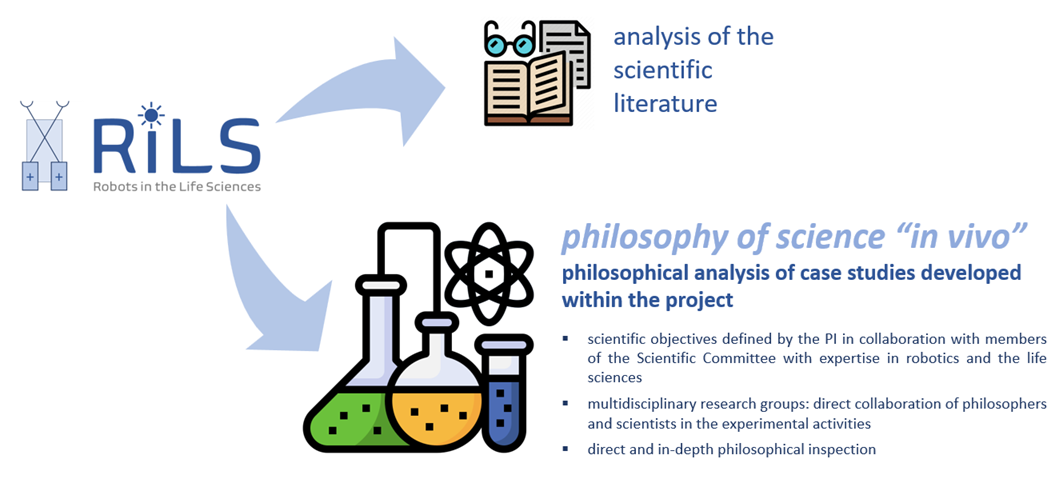
RiLS will establish a distinctive ecosystem for philosophical research. Hybrid research groups comprising scientists and philosophers of science will be established. Scientific case studies will be organised and philosophically probed within the project, providing an exceptional perspective on the important philosophical issues in biorobotics.
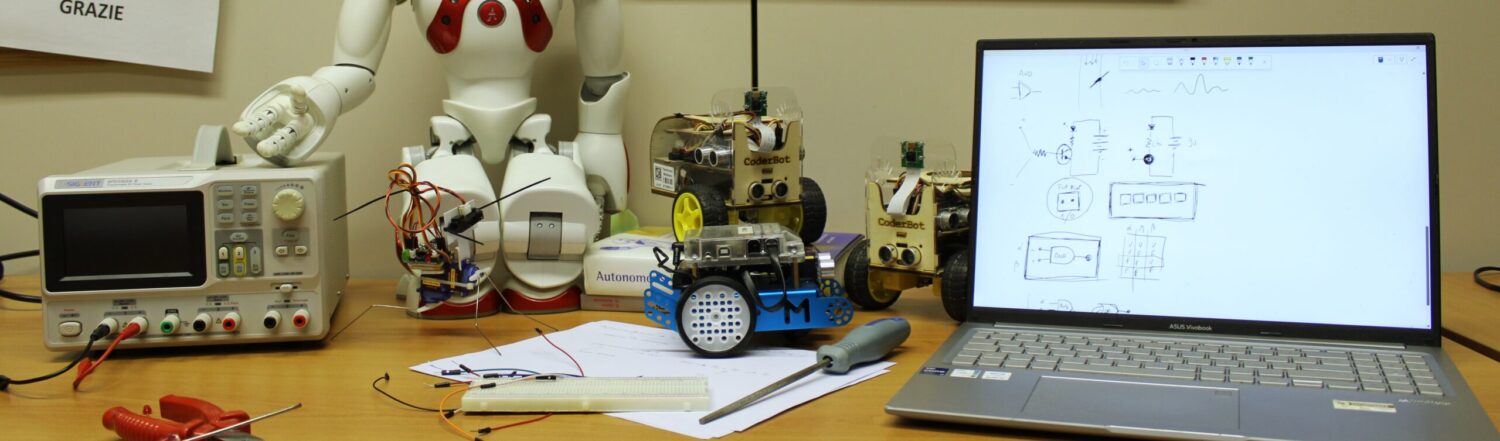
The RiLS team will comprise six postdoctoral researchers plus PhD students and research collaborators. The RobotiCSS Lab has several facilities for robotics and human-robot interaction research, including three humanoid robots (NAO, Pepper and Unitree G1), a quadrupedal robot (Unitree GO2), numerous non-humanoid robots, a Tobii Pro Glasses eye tracker, a VICON system for behavioural tracking and equipment for robotic design and electronic prototyping.
Networking
Establishment of a RiLS international network
We will establish a RiLS research network, comprising leading scholars from the relevant fields of philosophy, history, science and technology. It may be formalised as an international association to facilitate the achievement of the project’s scientific objectives, the organization of international conferences, the creation of partnerships for post-RiLS research grant proposals.
Organization of seminars and conferences
We will organise a RiLS Permanent Seminar comprising interdisciplinary seminars held online or in person every two months, as well as a RiLS International Conference at the end of the project.
Establishment of a Centre of Excellence
The RobotiCSS Lab of the University of Milano-Bicocca is a unique research centre where philosophical and empirical research are deeply intertwined, in line with the “Philosophy of Science in vivo” approach. One of RiLS’s goals will be to develop the laboratory into a centre of excellence for interdisciplinary research in the philosophy of robotics and cognitive science at the European level.