
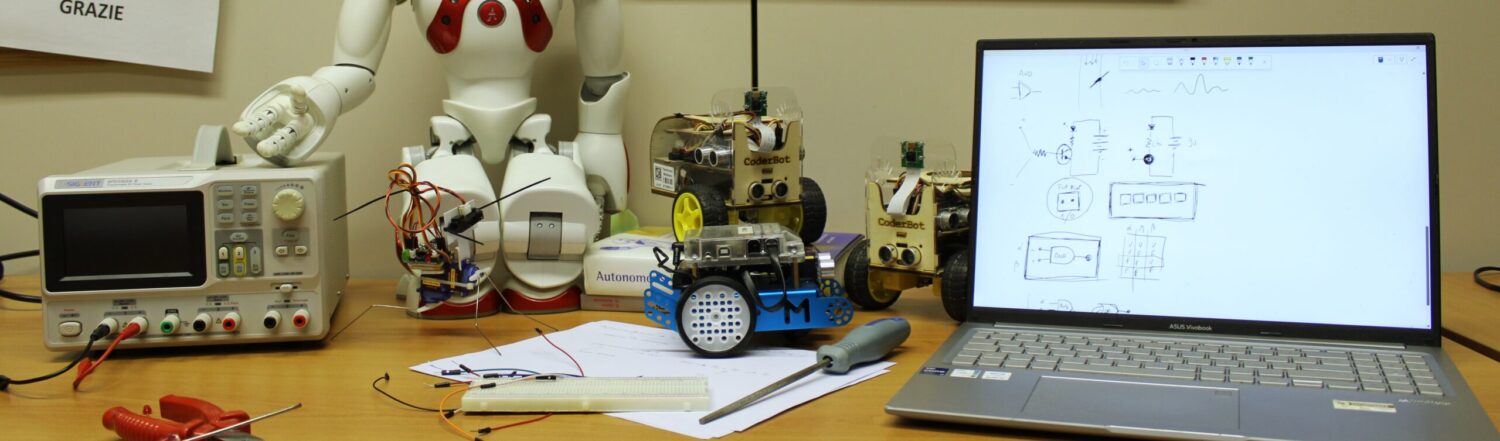
An increasing body of scientific literature focuses on how people understand and perceive robots. This scientific endeavour raises several philosophical questions pertaining to the philosophy of science, mind, cognition and language. In the Lab we try to address some of these questions, also relying on the analysis of case studies carried out within the lab itself (the “in vivo” approach).
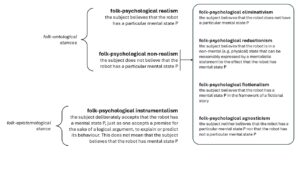
Folk-ontological stances towards robots
When people attribute mental states to robots, do they believe that these mental states exist? We have proposed an analysis of ‘mental state attribution’ that draws on the distinction between ‘belief’ and ‘acceptance’, as well as a provisional taxonomy of possible beliefs concerning the reality of robots’ minds. This taxonomy is loosely informed by philosophical theories on scientific ontology. This may help to resolve puzzling cases in which people explicitly deny that robots have mental states yet still interact with them as if they do. We are developing methods to study folk-ontological stances in collaboration with leading scientists specialising in mental state attribution.
- Datteri, E. (2025). Folk-Ontological Stances Towards Robots and Psychological Human Likeness. International Journal of Social Robotics, 17(2), 257–276. https://doi.org/10.1007/s12369-025-01225-6 [Open Access – PDF]
- Thellman, S., Bergsten, K., Datteri, E., & Ziemke, T. (2026). Realist, Anti-realist, or Agnostic? Exploring Folk-Ontological Stances toward Robot Minds. Companion Proceedings of the 21st ACM/IEEE International Conference on Human-Robot Interaction, 332–335. https://doi.org/10.1145/3776734.3794410
See also:
- Datteri, E. (2026). The Attribution of Rationality to Robots. Croatian Journal of Philosophy, 26(76), 17–39. https://doi.org/10.52685/cjp.26.76.2
Anthropomorphising robots: culture as a mediator
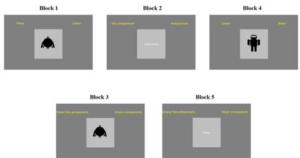
An intriguing and plausible hypothesis is that people’s cultural profiles affect how they perceive and understand robots. While many empirical studies on this relationship exist, we have argued that they essentially rely on a geographical conception of culture. According to this conception, people’s culture is operationalised as their nationality. However, it is reasonable to suggest that, particularly in our rich and diverse world, a variety of cultures can exist within national borders, rendering this geographical approach inadequate. For this reason, we are using non-geographical indicators of cultural profiles to study implicit anthropomorphism and understanding of the mind. We are also examining how personal tendencies to avoid uncertainty in life affect willingness to use social robots, building on well-established technology acceptance models.
- Roselli, C., Lapomarda, L., Larghi, S., Zagni, N., & Datteri, E. (2026). Culture and anthropomorphism towards robots in middle school students: Evidence from human–robot interaction. Scientific Reports. https://doi.org/10.1038/s41598-026-44312-y
- Lapomarda, L., Barco, A., & Datteri, E. (2026). A Non-geographical Approach to the Study of Culture-Mediated Acceptance of Social Robots. In J. Proença, R. Fervari, M. A. Martins, R. Kahle, & G. Pluck (Eds.), Software Engineering and Formal Methods. SEFM 2024 Collocated Workshops (Vol. 15551, pp. 219–236). Springer Nature Switzerland. https://doi.org/10.1007/978-3-031-94748-3_17
- Roselli, C., Lapomarda, L., & Datteri, E. (2025). How culture modulates anthropomorphism in Human-Robot Interaction: A review. Acta Psychologica, 255, 104871. https://doi.org/10.1016/j.actpsy.2025.104871
Folk cognitive science
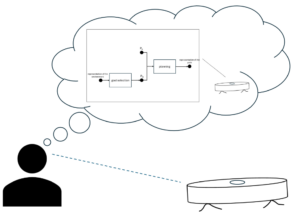
The psychology we do every day when we interact with other people is known as folk psychology. It is usually based on attributing so-called propositional attitudes, such as beliefs, desires and intentions, to others. As many scholars of human-robot interaction have demonstrated, people appear to attribute these propositional attitudes to robots, thereby developing folk psychological accounts of their behaviour. However, we have argued that this is not the only way in which people may mentalise robots. Specifically, in some cases people tend to use concepts drawn from cognitive science rather than folk psychology to talk about robots. Instead of attributing beliefs, desires and intentions, they often attribute internal maps, mental algorithms and cognitive processes. This models the robot’s mind in a way that is very similar to how cognitive science models the human mind. We have developed the notion of ‘folk cognitive science’ to denote this approach, drawing on philosophical analysis and a qualitative investigation of people’s explanations of robots’ behaviour.
- Larghi, S., & Datteri, E. (2024). Mentalistic Stances Towards AI Systems: Beyond the Intentional Stance. In Aldini A. (Ed.), Lect. Notes Comput. Sci.: Vol. 14568 LNCS (pp. 28–41). Springer Science and Business Media Deutschland GmbH; Scopus. https://doi.org/10.1007/978-3-031-66021-4_2