
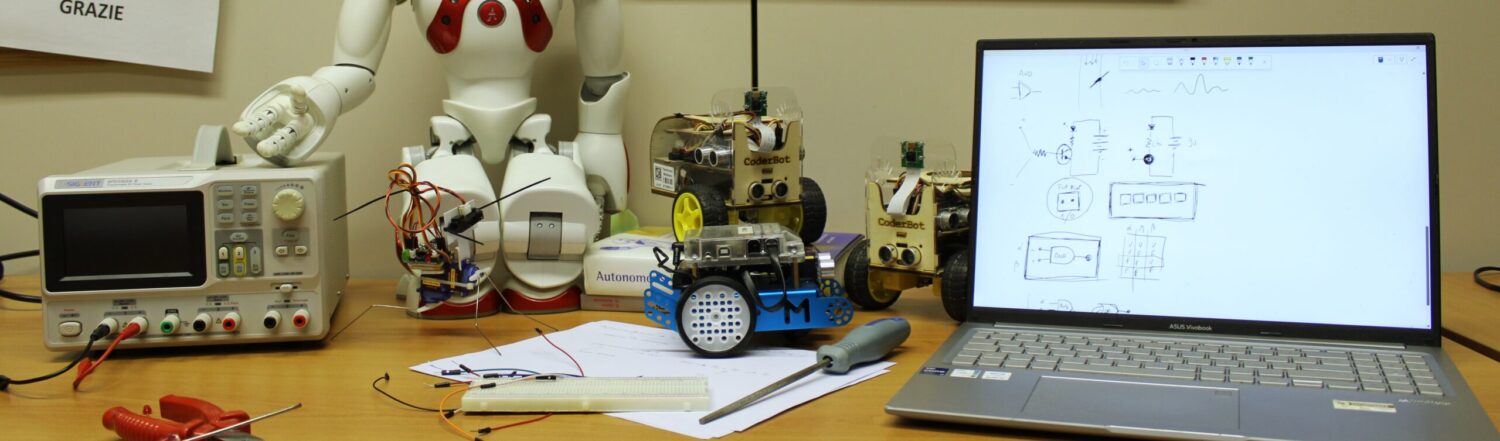

I am a Full Professor of Logic and Philosophy of Science at the University of Milano-Bicocca, and director of the RobotiCSS Lab. I am fascinated by the idea of using robots as scientific models to study animal cognition and behaviour, humans included – an idea that dates back to cybernetics and the golden era of artificial intelligence, and is now being revived in biorobotics and social robotics. I am the author of several philosophical articles on this subject. I also have fun (and learn a lot about science) by coordinating empirical studies that rely on the facilities of the RobotiCSS lab. I am the Principal Investigator of the FIS project ‘RiLS’. You can find an organised overview of the research activities that I have carried out and coordinated on the pages about biorobotics and human-robot interaction.
Email address: edoardo.datteri at unimib.it
Visiting address: Piazza dell’Ateneo Nuovo 1, 20126 Milano (MI), Building U6, fourth floor, room 4153
Peer-reviewed articles published in international journals
- Roselli, C., Lapomarda, L., Larghi, S., Zagni, N., & Datteri, E. (2026). Culture and anthropomorphism towards robots in middle school students: Evidence from human–robot interaction. Scientific Reports. https://doi.org/10.1038/s41598-026-44312-y
- Datteri, E. (2026). The Attribution of Rationality to Robots. Croatian Journal of Philosophy, 26(76), 17–39. https://doi.org/10.52685/cjp.26.76.2
- Grazzani, I., Conte, E., & Datteri, E. (2026). False belief attribution in toddlers: An exploratory study with a novel unexpected-identity task. Frontiers in Developmental Psychology, 4, 1727052. https://doi.org/10.3389/fdpys.2026.1727052
- Pivetti, M., Di Battista, S., Bozzi, G., Merisio, C., & Datteri, E. (2026). What is a Programming Error? A Thematic Analysis of Teachers’ Views on Errors. Technology, Knowledge and Learning. https://doi.org/10.1007/s10758-025-09950-7
- Roselli, C., Lapomarda, L., & Datteri, E. (2025). How culture modulates anthropomorphism in Human-Robot Interaction: A review. Acta Psychologica, 255, 104871. https://doi.org/10.1016/j.actpsy.2025.104871
- Datteri, E. (2025). Models for Surrogative Stimulation. Erkenntnis. https://doi.org/10.1007/s10670-025-00951-7
- Datteri, E. (2025), “Folk-ontological stances towards robots and psychological human likeness”, International Journal of Social Robotics, 17, 257-276, https://doi.org/10.1007/s12369-025-01225-6
- Datteri, E., & Schiaffonati, V. (2023). “Computer simulations and surrogative reasoning for the design of new robots”. Synthese, 202(1), 5. https://doi.org/10.1007/s11229-023-04220-4
- Datteri, E., Chaminade, T., & Romano, D. (2022). “Going Beyond the “Synthetic Method”: New Paradigms Cross-Fertilizing Robotics and Cognitive Neuroscience”. Frontiers in Psychology, 13(June), 1–13. https://doi.org/10.3389/fpsyg.2022.819042
- Tamborini, M., & Datteri, E. (2023). Is biorobotics science? Some theoretical reflections. Bioinspiration & Biomimetics, 18(1), 015005. https://doi.org/10.1088/1748-3190/aca24b
- Datteri, E. (2021), “The creation of phenomena in interactive biorobotics”, Biological Cybernetics, 115:6, pp. 629-642, Open Access, https://doi.org/10.1007/s00422-021-00900-x
- Datteri, E. (2021), “Interactive biorobotics”, Synthese, 198, p. 7577-7595, ISSN: 0039-7857, doi: 10.1007/s11229-020-02533-2
- Datteri, E. (2020), “The Logic of Interactive Biorobotics”, Frontiers in Bioengineering and Biotechnology. Bionics and Biomimetics, 8:637, doi: 10.3389/fbioe.2020.00637
- Pennazio, V., Fedeli, L., Crifaci, G., Datteri, E., “Robotica e mondi virtuali per lo sviluppo delle abilità sociali nei bambini con autismo: una riflessione metodologica”, Sistemi Intelligenti, 32:1, pp. 139-154.
- Pucciarelli, M., Virgulti, L., Farina, E., Datteri, E. (2020), “Robot non umanoidi e non sociali per lo studio dell’attribuzione di intenzionalità in bambini con autismo”, Sistemi Intelligenti, 32:1, 107-122.
- Datteri (2020), “Biological accuracy in large-scale brain simulations“, History and Philosophy of the Life Sciences, 42:5, https://doi.org/10.1007/s40656-020-0299-1
- Datteri, E. (2019), “The epistemic roles of automata from cybernetics to contemporary robotics”, Rosmini Studies, 6, 245-256.
- Datteri, E., Schiaffonati, V. (2019), “Robotic simulations, simulations of robots”, Minds and Machines 29:1, 109-125 (Scopus).
- Di Maio, G., Murgia, E., Datteri, E. (2018), “I bambini e la robot-etologia: riflessioni epistemologiche sugli stili di spiegazione del comportamento dei robot”, Mondo Digitale, 75 (Scopus).
- Datteri, E. (2017), “The epistemic value of brain-machine interfaces for the study of the brain”, Minds and Machines 27:2, 287–313 (Scopus).
- Datteri, E., Zecca, L. (2016) “The Game of Science: an Experiment in Robo-Ethology with Primary School Children”, IEEE Robotics and Automation Magazine, 23:2, 24-29 (Scopus).
- Datteri, E., Laudisa, F. (2015), “Large-scale simulations of brain mechanisms: beyond the synthetic method”, Paradigmi, 23:3, 23-46.
- Datteri, E., Bozzi, G., Zecca, L. (2015), “Il ‘gioco dello scienziato’ per l’apprendimento delle competenze scientifiche nella scuola primaria”, Tecnologie Didattiche, 23:3.
- Datteri, E., Laudisa, F. (2014), “Box-and-arrow explanations need not be more abstract than neuroscientific mechanism descriptions”, Frontiers in Theoretical and Philosophical Psychology, 5:464 (doi: 10.3389/fpsyg.2014.00464; Scopus).
- Datteri (2014), “La robotica al servizio delle neuroscienze: stato dell’arte e problemi aperti”, Mondo Digitale, 55 (Scopus).
- Datteri, E., Zecca, L., Laudisa, F., Castiglioni, M. (2013), “Learning to explain: the role of educational robots in science education”, Themes in Science & Technology Education, 6:1, 29-38.
- Datteri, E. (2013), “Predicting the Long-Term Effects of Human-Robot Interaction: A Reflection on Responsibility in Medical Robotics”, Science and Engineering Ethics, 19:1, 139-60 (doi: 10.1007/s11948-011-9301-3; PMID: 21800171; Scopus).
- Datteri, E., Laudisa, F. (2012), “Model testing, prediction and experimental protocols in neuroscience: a case study”, Studies in History and Philosophy of Science Part C: Studies in History and Philosophy of Biological and Biomedical Sciences, 43:3, 602-610 (doi: 10.1016/j.shpsc.2012.04.001; ISSN: 13698486; ISI: 22627322; Scopus).
- Datteri, E. (2011), “Prediction and experimental protocols in neuroscience: a case study”, in Logic and Philosophy of Science, 9:1, 373-379 (ISSN: 1826-1043).
- Datteri, E., Laudisa, F. (2010), “Simulazione e spiegazione: il ruolo delle leggi nei modelli neuroscientifici”, Sistemi Intelligenti, 22:1, 89-118 (doi: 10.1422/31951).
- Datteri, E., (2009), “Simulation experiments in bionics: a regulative methodological perspective”, Biology and Philosophy, 24:3, 301-324 (doi: 10.1007/s10539-008-9133-y; Scopus: BIOPE; ISI: 000266477800003).
- Trautteur, G., Datteri, E., Santoro, M. (2008), “Empirically testable models are needed for understanding visual prediction”, Behavioral and Brain Sciences, commentario su Nijhawan, R., “Visual Prediction: Psychophysics and neurophysiology of compensation for time delays”, 31:2, 217-218 (doi: 10.1017/S0140525X08004019; Scopus: BBSCD; ISI: 000258542000048).
- Salvini, P., Datteri, E., Laschi, C., Dario, P. (2008), “Scientific models and ethical issues in hybrid bionic systems research”, AI and Society, 22:3, 431-448 (doi: 10.1007/s00146-007-0158-6; ISI: 10316078; Scopus).
- Datteri, E., Tamburrini, G. (2007), “Biorobotic Experiments for the Discovery of Biological Mechanisms”, Philosophy of Science, 74:3, 409-430 (doi: 10.1086/522095; ISI: 000250832200007; Scopus).
- Datteri, E., Hosni, H., Tamburrini, G. (2005), “Machine Learning from Examples: A Non-Inductivist Analysis”, Logic and Philosophy of Science, 3:1 (ISSN: 1826-1043).
- Tamburrini, G., Datteri, E. (2005), “Machine Experiments and Theoretical Modelling: from Cybernetic Methodology to Neuro-Robotics”, Minds and Machines, 15:3-4, 335-358 (doi: 10.1007/s11023-005-2924-x; Scopus: MMACE; ISI: 00023420500000
Peer-reviewed articles published in Italian journals
- Silvia Larghi & Edoardo Datteri. (2025). Le scienze cognitive del senso comune. Sistemi intelligenti, (3), 445–463. https://doi.org/10.1422/119083
- Pisaneschi, G., Datteri, E. (2024), “L’interazione tra umani e robot come gioco di finzione”, Sistemi Intelligenti, 36(1), 9-24.
- Datteri, E., Zecca, L. (2018), “Metodi e tecnologie per l’uso didattico dei robot”, Mondo Digitale 75 (Scopus).
- Datteri, E., Zecca, L. (2017), “Theoretical vocabularies and styles of explanation of robot behaviours in children”, Research on Education and Media, Open Access, doi: https://doi.org/10.1515/rem-2017-0002
- Zecca, L., Datteri, E. (2017), “I robot nella Scuola Secondaria di Primo Grado: un’analisi degli stili di conduzione degli insegnanti”, Pedagogika, XXI
- Datteri, E. (2013), “I ‘Veicoli pensanti’ nell’immaginario della robotica contemporanea”, Sistemi Intelligenti, 3:25, 617-635 (doi: 10.1422/76305; Scopus).
- Datteri, E. (2010), “Danni senza anomalie: questioni di responsabilità nella robotica medica”, Informatica e Diritto, 1, 59-80.
- Datteri, E. (2007), “Integrazione uomo-macchina: modelli neuroscientifici e problemi di controllabilità”, Annuario di Etica, 4, 73-86.
- Fabris, A., Bartolommei, S., Datteri, E. (2007), “Which Ethics for Robotics?/Quale Etica per la Robotica?”, Teoria, 3:2, 7-17.
Book chapters
- Datteri, E (2024), “From the Restless COG to the Yawning Robot: Humanoid Robotics as a Model-Based Science”, in Ippoliti, E., Magnani, L., Arfini, S. (eds.), Model-Based Reasoning, Abductive Cognition, Creativity. Inferences and Models in Science, Logic, Language, and Technology, Springer.
- Datteri, E., Larghi, S. (2024), “La psicologia dei robot”, in Galletti M., Zipoli Caiani, S. (eds), Filosofia dell’Intelligenza Artificiale, Il Mulino.
- Zampini, L., Farina, E., Datteri, E. (2022), “Robots for the study of false belief attribution in autistic children: An exploratory study”, in Datteri, E., Zecca, L. (a cura di), Inclusive Science Education and Robotics, Franco Angeli, ISBN: 9788835150640
- Datteri, E. (2022), “I robot come strumenti di conoscenza”. In Grimaldi, R. (a cura di), La società dei robot, Mondadori.
- Datteri, E., Zecca, L. (2021), “Le implicazioni etiche degli usi educativi e didattici dei robot”, in Fossa, F., Schiaffonati, V., Tamburrini, G. (a cura di), Automi e persone. Introduzione all’etica dell’intelligenza artificiale e della robotica. Carocci, Roma.
- Merisio, C., Bozzi, G., Datteri, E. (2021), “There is No Such Thing as a ‘Trial and Error Strategy’”. In Malvezzi, M., Alimisis, D., Moro, M. (a cura di), Education in & with Robotics to Foster 21st-Century Skills. EDUROBOTICS 2021. STUDIES IN COMPUTATIONAL INTELLIGENCE, 982, p. 190-201, Springer, Cham, ISBN: 978-3-030-77021-1, ISSN: 1860-949X, doi: 10.1007/978-3-030-77022-8_17
- Datteri, E., (2021), “Robots and Bionic Systems as Experimental Platforms for the Study of Animal and Human Behaviour”. In Chiodo, A., Schiaffonati, V. (a cura di), Italian Philosophy of Technology. Socio-Cultural, Legal, Scientific and Aesthetic Perspectives on Technology. vol. 35, p. 181-197, Springer Nature, ISBN: 978-3-030-54521-5, doi: 10.1007/978-3-030-54522-2_12
- Datteri, E., Cabitza, F. (2021), “Gli errori nella programmazione di sistemi robotici”, in Bozzi, G., Datteri, E., Zecca, L. (a cura di), Interazione bambini-robot. Riflessioni teoriche, risultati sperimentali, esperienze, Franco Angeli, Milano.
- Datteri, E. (2020), “Gli automi come strumenti di conoscenza. Alcune questioni di metodo scientifico”, In Pacitto, M.F. (a cura di), Convegni cassinati (pp. 135-152). Aracne.
- Datteri, E. (2019), “Large-scale computer models of the brain: is there a ‘right’ level of detail?”, in Berkich, D., D’Alfonso, M.V., On the Cognitive, Ethical, and Scientific Dimensions of Artificial Intelligence, Springer, 205-219 (DOI: 10.1007/978-3-030-01800-9_11).
- Datteri, E. (2017), “Biorobotics”, in L. Magnani T. Bertolotti (eds.), Springer Handbook of Model Based Science, Springer, Heildelberg/Berlin, 817-837.
- Datteri, E. (2015), “Intelligenza Artificiale e scienze della natura”, in P. Pecere (ed), Il libro della natura. II. Scienze e filosofia da Einstein alle neuroscienze contemporanee, Carocci, Roma, 265-300 (ISBN: 978-88-430-7833-2).
- Datteri, E. (2014), “Biorobotics: A Methodological Primer”. In Amigoni, F., Schiaffonati, V. (eds), Methods and Experimental Techiques in Computer Engineering, Springer, 71-86 (doi: 10.1007/978-3-319-00272-9_5).
- Datteri, E., Tamburrini, G. (2013), “Robotic weapons and democratic decision-making”, in Hilgendorf, E., Günther, J. P., Robotik und Gesetzgebung, Nomos, 211-229 (ISBN: 978-3-8329-7705-4).
- Datteri, E., Tamburrini, G. (2010), “Robotica medica e società”, voce enciclopedica dell’Opera XXI Secolo – Il corpo e la mente”, Istituto della Enciclopedia Italiana Fondato da Giovanni Treccani, 339-348.
- Datteri, E., Tamburrini, G., (2009) “Ethical reflections on health care robotics”, in R. Capurro and M. Nagenborg (Eds.): Ethics and Robotics. Heidelberg: Akad.Verlagsgesellschaft (ISBN 978-3-89838-087-4 (AKA) and 978-1-60750-008-7 (IOS Press), 35-48.
- Datteri, E., Tamburrini, G. (2009), “Robotica, etica e conoscenza scientifica”, in Fuschetto, C., Greco P. (ed.), Scienza e coscienza delle macchine, CUEN, Napoli, 119-131 (ISBN: 8871467701).
- Datteri, E. (2008), “Intelligenza Artificiale: Elaborazione simbolica e coordinazione senso-motoria”, in Rainone, A., Gensini, S. (eds), La mente. Tradizioni filosofiche, prospettive scientifiche, paradigmi contemporanei, Carocci, Roma, 237-254. (ISBN: 978-88-430-4693-5).
- Datteri, E., Tamburrini, G. (2006), “Meccanismi di coordinazione sensomotoria e modelli computazionali”, in Cherubini, P., Giaretta, P., Marraffa, M., Paternoster, A. (eds), Cognizione e computazione. Problemi, metodi e prospettive delle spiegazioni computazionali nelle scienze cognitive, CLEUP, Padova, 77-96 (ISBN 88-6129-010-8).
- Datteri, E., Tamburrini, G. (2004), “Bio-robotica e spiegazione del comportamento adattativo non intenzionale”, in Jervolino, D., Pititto, R. (eds), Linguaggi – Fenomenologia – Ricerche cognitive, 3, 173-190 (ISBN 88-7325-082-3).
Conference Proceedings
- Thellman, S., Bergsten, K., Datteri, E., & Ziemke, T. (2026). Realist, Anti-realist, or Agnostic? Exploring Folk-Ontological Stances toward Robot Minds. Companion Proceedings of the 21st ACM/IEEE International Conference on Human-Robot Interaction, 332–335. https://doi.org/10.1145/3776734.3794410
- Larghi, S., Caldiroli, C. L., Lapomarda, L., & Datteri, E. (2026). Exploring Mentalising Tendencies Toward a Non-Humanoid Robot in Individuals with Autism Spectrum Disorder: A Pilot Study. In M. Staffa, J.-J. Cabibihan, B. Siciliano, S. S. Ge, L. Bodenhagen, A. Tapus, S. Rossi, F. Cavallo, L. Fiorini, M. Matarese, & H. He (Eds.), Social Robotics + AI (Vol. 16131, pp. 399–412). Springer Nature Singapore. https://doi.org/10.1007/978-981-95-2379-5_27
- Lapomarda, L., Barco, A., & Datteri, E. (2026). A Non-geographical Approach to the Study of Culture-Mediated Acceptance of Social Robots. In J. Proença, R. Fervari, M. A. Martins, R. Kahle, & G. Pluck (Eds.), Software Engineering and Formal Methods. SEFM 2024 Collocated Workshops (Vol. 15551, pp. 219–236). Springer Nature Switzerland. https://doi.org/10.1007/978-3-031-94748-3_17
- Augello, A., Datteri, E., Lieto, A., Rausa, M., & Zagni, N. (2026). RAGGAE for HERBS: Testing the Explanatory Performance of Ontology-Powered LLMs for Human Explanation of Robotic Behaviors. In M. Staffa, J.-J. Cabibihan, B. Siciliano, S. S. Ge, L. Bodenhagen, A. Tapus, S. Rossi, F. Cavallo, L. Fiorini, M. Matarese, & H. He (Eds.), Social Robotics + AI (Vol. 16133, pp. 558–569). Springer Nature Singapore. https://doi.org/10.1007/978-981-95-2398-6_37
- Augello, A., Rausa, M., Datteri, E., Zagni, N., & Lieto, A. (2025). How are people’s explanations of the behaviour of robots structured? An exploratory study and discussion. 2025 IEEE Conference on Pervasive and Intelligent Computing (PICom), 66–73. https://doi.org/10.1109/PICom68402.2025.00015
- Larghi, S., & Datteri, E. (2024). Mentalistic Stances Towards AI Systems: Beyond the Intentional Stance. In Aldini A. (Ed.), Lect. Notes Comput. Sci.: 14568 LNCS (pp. 28–41). Springer Science and Business Media Deutschland GmbH. Scopus. https://doi.org/10.1007/978-3-031-66021-4_2
- Datteri, E. (2021), “The methods of biorobotics”, in Proceedings of ALIFS 2021: The 2021 Conference on Artificial Life. doi: https://dx.doi.org/10.1162/isal_a_00378, https://direct.mit.edu/isal/proceedings/isal/33/38/102947
- Cabitza, F., Campagner, A., Datteri, E. (2020), “To Err is (only) Human. Reflections on How to Move from Accuracy to Trust for Medical AI”, In Ceci, F., Prencipe, A., Spagnoletti, P. (a cura di), Exploring Innovation in a Digital World: Cultural and Organizational Challenges. Proceedings of the Annual conference of the Italian Chapter of AIS, 2020 (ISBN: 978-3-030-87841-2), pp. 36-49, Cham, Springer. doi: https://dx.doi.org/10.1007/978-3-030-87842-9_4
- Datteri, E., Zecca, L. (2015), “Il ‘gioco dello scienziato’: un robot per imparare a spiegare”, Mondo Digitale, 58 (ISSN 1720-898X; Scopus) [http://mondodigitale.aicanet.net/2015-3/dida5/didamatica2015_submission_60.pdf].
- Datteri E., Zecca L., Laudisa F., Castiglioni M. (2012), “Explaining robotic behaviors: a case study in science education”, negli atti del terzo convegno internazionale Teaching Robotics Teaching with Robotics: Integrating Robotics in School Curriculum, Riva del Garda, 20 Aprile 2012.
- Datteri, E. (2010), “Bionic simulation of biological systems: a methodological analysis”, in D’Agostino, M., Giorello, G., Laudisa, F., Pievani, T., Sinigaglia, C., New Essays in Logic and Philosophy of Science, Atti del convegno SILFS 2007 – International Conference of the Italian Society for Logic and Philosophy of Science, 8-10 Ottobre 2007, College Publications, London, 711-723 (ISBN: 1848900031).
- Datteri, E. (2010), “Simulazioni, spiegazioni e generalizzazioni nelle scienze cognitive”, Sistemi Intelligenti, Atti del Sesto Convegno dell’Associazione Italiana di Scienze Cognitive, AISC 09, 22:3, 459-466 (doi: 10.1422/33545).
- Tamburrini, G., Datteri, E. (2008), “Computation and the explanation of intelligent behaviours: ethologically motivated restart”, in Andretta, A., Kearnes, K., Zambella, D., Logic Colloquium 2004, Lecture Notes in Logic, Cambridge University Press, 168-186 (ISBN: 9780521884242).
- Datteri, E., Tamburrini, G. (2006), “Bio-robotic experiments and scientific method”, in Magnani, L., Dossena, R. (eds), Computing, Philosophy and Cognition, College Publications, London, 397-410 (ISBN: 1-904987-24-9).
- Datteri, E., Hosni, H., Tamburrini, G. (2006), “An inductionless and default-based analysis of machine learning procedures”, in Magnani, L. (ed.), Model Based Reasoning in Science and Engineering, College Publications, 379-399 (ISBN: 1-904987-23-0).
- Tamburrini, G., Datteri, E., (2005), “Computation and the explanation of intelligent behaviours: ethologically motivated restart”, abstract pubblicato sul Bulletin of Symbolic Logic, 11:2, 254-255.
- Datteri, E., Asuni, G., Teti, G., Laschi, C., Dario, P., Guglielmelli, E. (2004), “Experimental Analysis of the Conditions of Applicability of a Robot Sensorimotor Coordination Scheme based on Expected Perception”, in the Proceedings of IROS 2004, 2004 IEEE/RSJ International Conference on Intelligent Robots and Systems, Sendai, Japan, September 28 – October 2 2004, Vol. 2, 1311 – 1316 (doi: 10.1109/IROS.2004.1389577).
- Datteri, E., Teti, G., Laschi, C., Tamburrini, G., Dario, P., Guglielmelli, E. (2003), “Expected perception in robots: a biologically driven perception-action scheme”, in Proceedings of ICAR 2003, 11th International Conference on Advanced Robotics, Vol. 3, 1405-1410 (Scopus).
- Datteri, E., Teti, G., Laschi, C., Tamburrini, G., Dario, P., Guglielmelli, E. (2003), “Expected perception: an anticipation-based perception-action scheme in robots”, in Proceedings of IROS 2003, 2003 IEEE/RSJ International Conference on Intelligent Robots and Systems, Las Vegas, Nevada, Vol. 1, 934- 939 (doi: 10.1109/IROS.2003.1250748, ISI: 8380365, Scopus: 62036).
- Laschi, C., Teti, G., Tamburrini, G., Datteri, E., Dario, P. (2001), “Adaptable semi-autonomy in personal robots”, in Proceedings of the 10th IEEE International Workshop on Robot and Human Interactive Communication, 18-21 Sept. 2001, Bordeaux-Paris, 152-157 (doi: 10.1109/ROMAN.2001.981894).